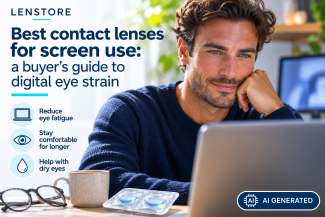
Best contact lenses for screen use: a buyer's guide to digital eye strain

Quick summary: Screens lower how often you blink, which dries out your contacts and makes digital eye strain worse by the afternoon. The best contacts for screen use are daily disposables or silicone hydrogel contacts built for moisture retention, such as 1 Day ACUVUE MOIST, Dailies AquaComfort Plus, or Biofinity Energys. Combine the right contacts with the 20-20-20 rule, deliberate blinking, and rewetting eye drops for the most comfortable screen time, whether you are working, gaming, or scrolling. 
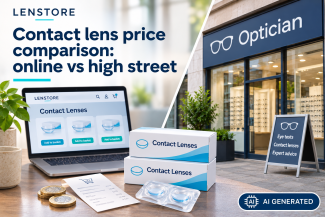
Contact lens price comparison: online vs high street

Contact lens prices vary between online retailers and high street opticians, with savings possible depending on where you buy and the lens type you choose. Price alone is not always the deciding factor, though; practical differences such as delivery, reordering, and subscriptions often matter just as much. This guide compares buying contacts online vs high street and weighs up the factors beyond price, so you can make an informed choice for your next order. 

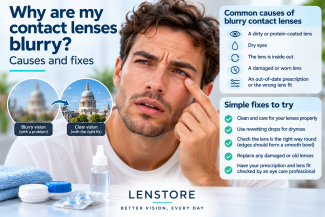
Why are my contact lenses blurry? Causes and fixes

Your lenses went in clear this morning, and by mid-afternoon the words on your screen have gone soft. A blink or two sharpens them, then the blur creeps back. It's one of the most common things wearers ask us about, and the reassuring part is that most causes are simple to fix at home. Blurry lenses usually come down to four things: dryness, a build-up on the lens, a lens that has shifted or gone in inside-out, or a prescription that no longer fits. Here's how to tell them apart, and what to do about each.

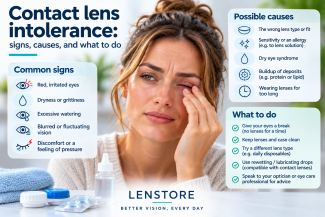
Contact lens intolerance: signs, causes, and what to do

Your lenses used to disappear the moment you put them in. Lately they nag. They feel dry by lunchtime and gritty by the afternoon. You want them out before dinner. That slow loss of comfort has a name: contact lens intolerance. It's rarely the end of wearing lenses. It's a sign that something about your lenses, your routine, or your tears has stopped agreeing. Most of it is fixable once you know what to look for. Let's walk through the signs, the usual causes, and what to do next.

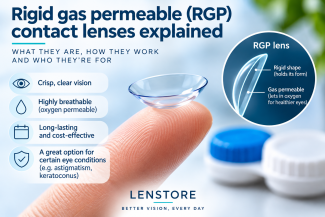
Rigid gas permeable (RGP) contact lenses explained

Pick up a soft contact lens and it flops over your fingertip. Pick up a rigid gas permeable lens and it holds its shape, like a tiny clear button. That firmness is the whole point: on the right eyes it gives sharper vision than a soft lens can, and it's the reason these lenses are fitted a little differently from the box you order online.

Rigid gas permeable lenses go by RGP for short, and some still call them hard lenses. They're a specialist option, not an everyday default. Here's what they are, how they differ from soft lenses, who they suit, and how you'd get a pair.

The UK Vision Report 2026

Reviewed by Morgan Sayes, Optometrist, GOC number 01-27300, for Lenstore

Published 26th October 2026. Survey fieldwork: August 2026. Sample: 1,030 UK adults aged 18 to 64.

The UK Vision Report 2026 is Lenstore's latest survey of how well the nation looks after its eyes. In August 2026 we asked 1,030 UK adults how often they have their eyes tested, how much time they spend on screens, what stops them getting checked, and how they feel about proposed mandatory eye tests for older drivers. 

Extended wear contact lenses, explained

Most contact lenses come out before bed. Extended wear contact lenses are the exception. With your optician's sign-off, you can leave them in overnight and wake up already able to see the clock across the room. There is a catch, though. A closed eye gets far less oxygen than an open one. So the idea only works because of what these lenses are made from, and how many nights you are cleared to wear them.

Ortho-k lenses explained: clear days without daytime lenses

Most contact lenses do their job while they sit in your eyes. Ortho-k lenses work the other way round. You wear them overnight. You take them out when you wake up. Then you go through the whole day seeing clearly, with nothing in your eyes at all.

It sounds almost too neat, so it helps to know what's really going on. Here's how ortho-k lenses work, who they suit, and why they start with an optometrist rather than an online order.