
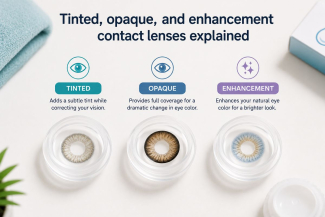
Tinted, opaque, and enhancement contact lenses explained
Shopping for coloured contact lenses and tripping over the labels can be genuinely confusing. The words 'tinted', 'enhancement', and 'opaque' get used as if you already know them. You don't have to, and sorting them out is easier than it first looks. Each type changes your eyes in its own way and by a different amount. So the right choice really comes down to how big a change you want, from a barely-there lift to a whole new eye colour by Friday night.
What 'tinted' actually means
Every coloured lens is, at its heart, a soft lens with colour set into the plastic. That colour is printed as a fine ring of dots and lines across the lens. The ring copies the pattern of your iris (the coloured part of your eye). The middle is left clear, so it sits over your pupil and you see as normal. This is why the whole category is often called tinted contact lenses.
So what really sets the types of coloured contact lenses apart from each other? It comes down to how much colour there is, and whether light passes through it. That single idea splits three ways: visibility tints, enhancement tints, and opaque tints. Lenstore stocks all three, from daily FreshLook One Day to monthly Air Optix Colors.
Visibility tints, the ones you barely notice
Ever fished a clear lens out of its case and nearly lost it in the solution? That little problem is exactly what a visibility tint is designed to solve. It's a faint blue or green tint added to an otherwise clear lens. The tint helps you spot the lens in its case, on your finger, or in the sink.
Biotrue ONEday dailies from Bausch & Lomb are a good everyday example. They carry a light blue handling tint on a lens that is 78% water. That tint is far too weak to change your eye colour or show in a photo. It is a handling aid, not a look you would notice on someone. Almost every clear daily hides one, so a visible change needs one of the next two.
Enhancement tints, your own colour turned up
Enhancement tints are for when you like your eye colour and simply want more of it. The tint is see-through, so it layers over your iris instead of covering it. That deepens what is already there, like blue eyes lifting to a brighter aqua. Green eyes can gain a little extra depth in the same gentle way.
Because the colour is see-through, enhancement tints work best on lighter eyes. On dark brown eyes, too little light comes back through for the effect to show. Want to test the idea without committing to a full month of wear? A daily coloured lens like FreshLook One Day costs around £9.99 for 10 lenses. You try a softer shade one day at a time, then bin the pair at night. There is no cleaning and no case to look after.
Opaque tints, a whole new eye colour
Going from dark brown to grey, or from green to blue, is opaque territory. These are the lenses most people mean by opaque contact lenses. Opaque tints use a solid colour that fully covers your natural shade. Light does not pass through the coloured part, so even dark eyes can change completely.
Keeping the result believable is the real skill, and it comes down to layering. Air Optix Colors (£15.99 a box, monthly) use a clever 3-in-1 colour design. That design combines an outer ring, an inner ring, and a central colour. The rings blend with your own eye, so the colour reads as real rather than flat. Nine shades are on offer, from subtle Pure Hazel and Grey to bold Brilliant Blue. Gemstone Green sits at the bolder end of that same range. The lens itself is a breathable silicone hydrogel (Lotrafilcon B, 33% water). Prefer a different monthly pick? FreshLook Colorblends gives a similar colour-changing effect.
So which coloured lens does what?
Here are the main coloured contact lenses differences, laid out at a glance:
Tint type | What it does to your eyes | Best for | A Lenstore option |
|---|---|---|---|
Visibility (handling) tint | Adds a faint blue or green tint so you can see a clear lens — no colour change | Any wearer; finding a dropped lens | Biotrue ONEday handling tint |
Enhancement tint | See-through colour that deepens your natural shade | Lighter eyes wanting a subtle lift | A daily coloured lens, e.g. FreshLook One Day |
Opaque tint | Solid colour that covers your natural shade | Darker eyes, or a bold new colour | Air Optix Colors (monthly) |
Read the table left to right and you can usually place yourself in one row. That is often enough to narrow things down before you even look at colours.
Do you need a prescription for coloured lenses?
Yes, and this is the part that is genuinely worth slowing down for. Coloured lenses come in two forms, and the difference matters more than the shade. Prescription lenses correct your sight while changing your colour at the same time. Plano lenses are purely cosmetic (zero-power), with no vision correction at all.
It is tempting to treat plano lenses like make-up, but they simply are not. In the UK, zero-power cosmetic lenses can only be supplied under professional supervision. That means a registered optometrist, a dispensing optician, or a doctor overseeing the sale. Plano wearers face the same risks to eye health as anyone in a prescription lens. [1] Every contact lens, coloured or clear, is a medical device that needs a proper fitting. [2]
The reason for all this care is fit, plain and simple. A lens that does not match the curve of your eye can rub the cornea. The cornea is the clear front surface of your eye, and it scratches easily. A poor fit, or a novelty lens from an unregulated seller, invites an eye infection. [3] So give the market-stall 'Halloween' lenses a miss this year. Get a quick fitting with your optician and buy only from a regulated retailer. It is a five-minute step that keeps your eyes safe and comfortable.
Choosing the look that's right for you
Match the tint to the size of the change you actually want to make. After a subtle, natural lift with light eyes? An enhancement shade in a daily is a low-stakes place to start. Chasing a bold, camera-ready colour over dark eyes? Opaque lenses like Air Optix Colors are built for exactly that. Just want to find your clear lens more easily? A visibility tint has you covered.
Whichever way you lean, it pays to plan for the upkeep as well. Daily coloured lenses are single-use, so there is nothing at all to clean. A monthly pair needs a multi-purpose solution and a case to stay fresh. When you are ready, browse the full range on our coloured contact lenses page. Book that fitting first, so your new look sits right from the very first day.
Sources
[1] The College of Optometrists — in the UK, zero-powered (plano) cosmetic contact lenses may only be supplied under the supervision of a registered optometrist, dispensing optician, or doctor, and plano wearers face the same ocular-health risks as powered-lens wearers.
[2] US Food and Drug Administration — decorative (coloured) contact lenses are medical devices, and all contact lenses, including decorative ones, must be prescribed by a doctor.
[3] US Centers for Disease Control and Prevention — decorative lenses that are not properly fitted can leave the eye vulnerable to corneal scratches or ulcers, which can lead to infection.