
How to read a contact lens prescription
You’ve completed your contact lens fitting and received your prescription — but what do all those numbers and abbreviations mean?
A contact lens prescription contains several measurements that help your optician select lenses that fit your eyes correctly and provide clear vision. Understanding these values can make it much easier to order contact lenses online.
This guide explains where to find your prescription and what each value means.
Where can I find my contact lens prescription?
Your contact lens prescription details can usually be found in one of the following places:
- On the prescription provided by your optician
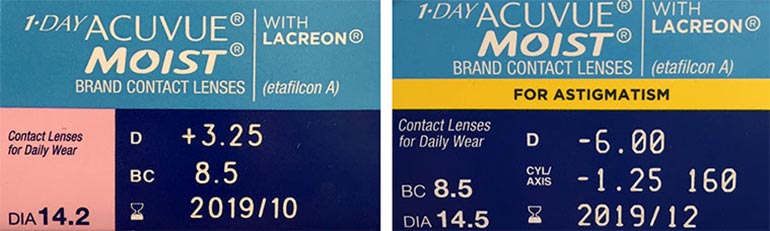
- On the side of your contact lens box
- On documentation from your contact lens fitting or aftercare appointment
If you can’t locate your prescription, contact your optician. They can provide the details of the contact lenses recommended for you.
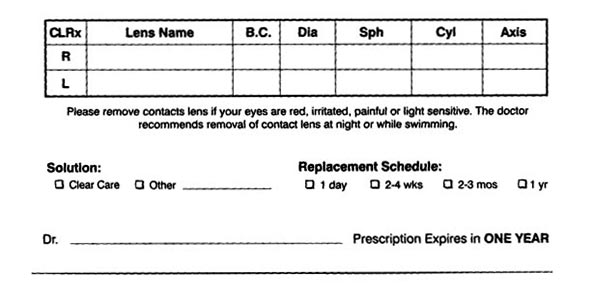
When you attend a contact lens fitting or check-up, your optician will normally give you a prescription form similar to the example below.
What do the numbers on a contact lens prescription mean?
A contact lens prescription usually includes several measurements. Each one helps ensure the lens fits properly and corrects your vision.
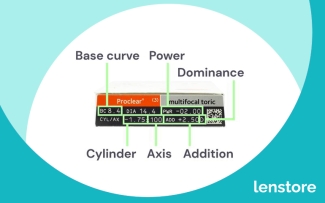
Base Curve (BC)
The base curve measures how curved your contact lenses are.
Your optician selects a base curve that matches the natural curvature of your cornea so that the lens fits comfortably and stays stable on the eye.
Example: BC 8.4
Diameter (DIA)
The diameter measures the width of the contact lens from one edge to the other.
This measurement ensures the lens covers the correct part of your eye.
Example: DIA 13.8
Power / Sphere (PWR or SPH)
The power of the lens corrects your vision and is measured in dioptres (D).
- A minus (-) value means you are short-sighted (myopia)
- A plus (+) value means you are long-sighted (hyperopia)
The higher the number, the stronger the correction required.
Contact lens brand or name
Most prescriptions include the brand or type of contact lens recommended by your optician. This ensures you reorder the correct lenses.
Examples include lenses from manufacturers such as:
Your optician recommends a specific lens based on fit, material and eye health.
Cylinder (CYL)
The cylinder value is used when correcting astigmatism.
Astigmatism occurs when the eye has an irregular curvature that affects how light focuses on the retina.
If you do not have astigmatism, this field may be blank.
Example: CYL -2.25
Axis
The axis works together with the cylinder value.
It describes the orientation (between 0 and 180 degrees) of the correction required for astigmatism.
Example: AXIS 10
Addition (ADD)
The addition value is used in multifocal contact lenses to help with near vision.
This measurement is commonly required for people with presbyopia, a condition that affects reading vision as we age.
ADD values may appear as:
- LOW
- MEDIUM
- HIGH
- Or a specific dioptre value
Are contact lens prescriptions the same as glasses prescriptions?
No — contact lens prescriptions and glasses prescriptions are different.
A contact lens sits directly on the surface of the eye, while glasses sit a short distance in front of the eye. Because of this difference, the lens power and measurements must be calculated differently.
A glasses prescription cannot be used to order contact lenses without adjustment by an optician.
A spectacle prescription will not usually include:
- Base curve (BC)
- Diameter (DIA)
- Contact lens brand or type
Your optician determines these measurements during a contact lens fitting.
Why having the correct prescription matters
Using the correct prescription helps ensure that your lenses:
- Fit comfortably
- Provide clear vision
- Maintain healthy oxygen flow to the cornea
- Reduce the risk of irritation or infection
Always follow the advice of your optician and attend regular eye checks to keep your prescription up to date.
Now that you understand how to read your prescription, you can browse our range of contact lenses from leading brands including ACUVUE, CooperVision and Alcon to find the lenses recommended for you.
