
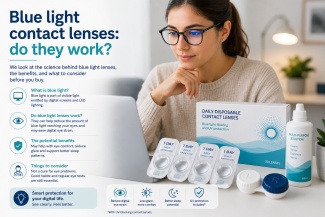
Blue light contact lenses: do they work?
Quick answer: blue light contact lenses use a tint or coating that absorbs a portion of the high-energy light coming from screens, but the evidence that this actually reduces digital eye strain, protects your macula, or improves sleep is thin. UK and US eye health bodies do not currently recommend them on the strength of that evidence. If screens are leaving your eyes tired, the bigger wins come from your screen habits and, for contact lens wearers, choosing contacts built for comfort during long digital sessions.
We spend more time staring at screens than ever, so it's no surprise that 'blue light contact lenses' has become a hot search term. Phones, laptops, and office lighting all give off blue light, and a growing range of products claim to filter it out before it reaches your eye. But do they actually work? We checked the research, what UK and US eye health bodies say, and what genuinely helps tired eyes by mid-afternoon. For the wider picture on screens and vision, our eye health hub is a good place to start.
What are blue light contact lenses?
Blue light contact lenses (also marketed as blue light filtering or blue light blocking contacts) contain a tint or coating designed to absorb some of the high-energy visible light given off by digital screens, LED bulbs, and daylight. They work on the same principle as blue light glasses, just sitting directly on your eye rather than in a frame.
They are not yet mainstream among major UK contact lens brands, and availability is limited for astigmatism, multifocal, or higher prescriptions.
How are they supposed to work?
The theory is straightforward. Screens, LED lighting, and daylight all emit light across the blue part of the visible spectrum. Because blue light has a shorter wavelength and higher energy than red or yellow light, some people believe it contributes to eye strain and, over time, might affect the retina. A blue light filter, whether in a lens, a coating, or a pair of glasses, is designed to absorb part of that light before it reaches the back of your eye.
It is a neat theory. The trouble is that the research has not caught up with the marketing.
What does the evidence actually say?
This is where things get interesting, because several major eye health organisations have looked into blue light filtering products and reached broadly the same conclusion.
- The American Academy of Ophthalmology states that several studies suggest blue light-blocking glasses do not improve symptoms of digital eye strain, and it does not recommend them. It also notes there is no measurable UVA or UVB radiation from computer screens, and no evidence that screen light damages the eyes.
- A Cochrane review, published in August 2023 and covering 17 randomised controlled trials with 619 participants, found low-certainty evidence that blue-light filtering spectacle lenses may not reduce short-term eye strain from computer work. It rated the sleep-quality evidence very low certainty, with mixed results across studies, and found no studies at all on macular health.
- The College of Optometrists in the UK reviewed the evidence in 2018 and does not recommend blue-blocking spectacle lenses for the general population. It found the evidence for eye strain, visual performance, and sleep quality to be low or very low quality, and said it remains unclear whether these lenses affect long-term macular health.
Worth flagging: all three reviews above focus on blue-light-blocking glasses, the most widely studied format. Contact lens-specific research is thinner still, though the filtering mechanism is the same.
Put simply: filtering out blue light is not proven to make your eyes feel better, sleep improve, or your long-term eye health change. That does not mean blue light lenses are harmful, just that the claims run well ahead of the evidence.
So why do screens make your eyes feel tired?
If blue light is not the main culprit, what is? Digital eye strain, or computer vision syndrome, is real, and usually comes down to a few overlapping habits rather than the light itself.
- You blink less. Reading of any kind cuts how often you blink, and research shows blinks become more incomplete specifically when reading from a screen rather than paper. Both dry out the eye's surface.
- You hold devices too close, or at the wrong angle, forcing your focusing muscles to work harder for longer.
- Glare, poor contrast, and harsh lighting all add to visual fatigue.
- Uncorrected or slightly out-of-date prescriptions make your eyes strain more than they need to.
If dryness is part of the problem, our guide to dry eye syndrome covers the causes and fixes in more depth.
What actually helps with digital eye strain
Since the research points away from blue light filters, here is what the evidence and everyday experience actually support.
- Follow the 20-20-20 rule: every 20 minutes, look at something 20 feet away for at least 20 seconds.
- Position screens roughly an arm's length away and slightly below eye level.
- Blink deliberately and often, especially during long reading or scrolling sessions.
- Keep artificial tears to hand if your eyes feel dry by the end of the day. Our range of eye drops covers most everyday dryness.
- Get your prescription checked regularly, since an outdated one is a common, overlooked cause of screen fatigue.
- If you wear contacts, choose a lens built with digital habits in mind. Biofinity Energys is a good example: it does not filter blue light, but its DigitalBoost technology eases focusing effort during close, prolonged screen use, and its Aquaform material helps combat dryness from blinking less while absorbed in a screen.
- Fresh, well-hydrated daily contact lenses can also help if end-of-day dryness is part of your problem, since you start each day with a clean, moisture-rich lens.
For a fuller checklist, our guide on how to avoid digital eye strain walks through habits you can build into your working day.
Should you try blue light contact lenses anyway?
If you like the idea and want to try a blue light filtering product, there is no evidence that they cause harm, just realistic expectations needed: the research does not currently support claims that they meaningfully reduce eye strain, protect your retina, or improve sleep. For comfort during long screen sessions, you are likely to get more noticeable results from good screen habits, proper hydration, and a lens designed around digital comfort rather than light filtering.
If you are considering a switch, it is worth a quick chat with your optician or contact lens supplier first, particularly if you wear toric or multifocal contacts, since blue light options are far less widely available in these fits.
Frequently asked questions
Do blue light contact lenses actually reduce eye strain?
The evidence does not reliably show that blue light contact lenses reduce eye strain. The American Academy of Ophthalmology, Cochrane, and the UK's College of Optometrists all rated the evidence low or very low certainty, and none currently recommend blue light filtering products.
Can blue light from screens actually damage your eyes?
No study has shown that blue light from screens damages your eyes. The American Academy of Ophthalmology has found no measurable UV radiation from computer screens and no scientific evidence that screen light harms the eyes, even after extended daily use.
What's the difference between blue light glasses and blue light contact lenses?
The difference between blue light glasses and blue light contact lenses is mainly where the filter sits: glasses use a coated or tinted lens in a frame, while contacts carry the same type of filter directly on the eye. Similarly limited evidence supports both.
Do blue light contact lenses help you sleep better?
The evidence does not reliably show that blue light contact lenses help you sleep better. A 2023 Cochrane review found very low-certainty, mixed evidence on sleep, with some trials showing improvement and others showing none.
Do I need blue light contacts if I already wear daily contacts?
You do not need blue light contacts if you already wear daily contacts, unless you specifically want to try a blue light filtering option. If screen-related dryness or tiredness is your main concern, a lens designed for digital comfort, alongside good screen habits, is likely to make more difference.
Are there contact lenses designed specifically for digital device use?
Yes, there are contact lenses designed specifically for digital device use, though they work differently to blue light filters. Biofinity Energys, for example, uses an optical design and moisture-locking material to ease focusing effort and dryness during long screen sessions, rather than filtering light.
If your eyes are feeling the strain of screen time, the fix is rarely about blocking blue light. It is about better screen habits and contacts that keep your eyes comfortable for the long haul.
Sources
American Academy of Ophthalmology: Are Blue Light-Blocking Glasses Worth It?
College of Optometrists: Blue blocking spectacle lenses position statement