
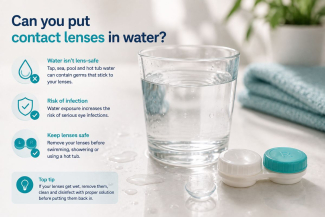
Can you put contact lenses in water?
You've run out of solution at bedtime, or you're about to jump in the pool with your lenses still in. People ask us the same thing all the time: can you put contacts in water, even for a minute? The honest answer is no. Contact lenses and water don't belong together, whether that's tap water, bottled water, or the pool, sea, or shower. Here's why that rule matters, and what to do when you're caught short.
The short answer: keep water and lenses apart
If you've ever wanted to rinse a lens under the tap, or leave it in a glass of water overnight, the answer is no. Water is not sterile, and your lens sits right against your cornea (the clear window at the front of your eye). Anything living in that water gets pressed against your eye and held there.
The organism opticians worry about most is Acanthamoeba, a microbe found in tap water, swimming pools, rivers, and the sea. It can cause a rare but serious eye infection called Acanthamoeba keratitis, which is painful and needs prompt treatment. According to the British Contact Lens Association, around 85% of these UK cases happen in contact lens wearers. [1] That figure is why the advice never changes: keep your lenses well away from water.
Why water is risky for your eyes
Tap water looks clean, and you drink it every day without a second thought. Your eye, though, is a different environment altogether. Even treated water carries small numbers of bacteria and other microbes, and while your stomach handles them easily, your cornea simply cannot.
A soft lens makes this worse because it is porous, soaking up water to stay comfortable (Live 1 Day lenses, for example, are 56% water). That means it traps whatever is in the water against the surface of your eye. A proper solution works in a completely different way. A multi-purpose solution like Opti-Free Puremoist disinfects your lenses, rinses off deposits, and matches the pH of your tears, while water does none of that. The US Food and Drug Administration puts it plainly: don't expose your contact lenses to any water, whether it's tap, bottled, distilled, lake, or ocean water. [2]
Swimming, showering, and hot tubs
Swimming with contact lenses is one of the questions we hear most. When you're on holiday, a hotel pool is hard to resist, and a hot shower after the gym feels like second nature. It's easy to forget about both. UK opticians generally advise against swimming in your lenses. Pool chlorine doesn't reliably kill this microbe, and open water in the sea, lakes, and rivers can carry it too.
If you truly can't avoid it, keep things simple. The British Contact Lens Association's advice is clear: watertight goggles that seal around your eyes, plus daily disposables you bin straight after. Our own Live 1 Day range fits that brief nicely. The same thinking covers your bathroom, so take your lenses out before you shower. And never wear them in a hot tub, where warm, shared water is another place these microbes thrive.
Caught without your solution? Here's what to do instead
No one likes running out of solution in a strange city, far from an open chemist. It's tempting to rinse your lenses under the tap, or leave them in a glass of water overnight. Don't. There are safer ways through the night:
- Pop in a spare pair of glasses instead, so you can take your lenses out and give your eyes a proper break.
- Keep a travel bottle in your bag, such as the ReNu Multi-Purpose Flight Pack (two 60ml bottles) that fits easily in hand luggage.
- Switch to daily disposables for trips, so there's no case and no contact lens solution to run out of in the first place.
- If a lens has dried out or touched water, open a fresh one rather than trying to rescue it.
Homemade saline and bottled water aren't safe stand-ins either, so if none of these are to hand, glasses win every time.
If a lens touches water, or your eye feels off
Say a splash catches you off guard, or your eye feels gritty, red, and watery after a swim. Take the lens out straight away. If it's a daily, throw it away, and if it's a reusable lens, disinfect it fully in fresh solution before it goes near your eye again. A rewetting drop like Systane Ultra can ease short-term dryness while your eyes settle, but eye drops don't clean your lenses, and they won't rescue one that has been in water.
An eye infection can look like ordinary irritation at first. Watch for lasting redness, pain, blurred vision, watering, or eyes that are sensitive to light, especially after any water contact. If you notice these signs, take your lenses out and see an optician or your GP promptly. Caught early, these infections are far easier to treat, and it's never something to self-diagnose or wait out.
Enjoying contacts and water, safely
An active, watery life and contact lenses really can go together. The golden rule is simply that the two stay apart: lenses out before you swim or shower, goggles on if you do end up in the pool, and a pair of glasses kept as backup. Daily disposables make all of this easiest, because there's nothing to store and you bin them after any risky moment.
Still weighing up your options? Our daily contact lenses are the simplest place to begin a swim-friendly routine, with everyday choices like Live 1 Day at £13.25 for 30 lenses. It's always worth a quick chat with your optician before you switch to a new lens.
Sources
[1] British Contact Lens Association — around 85% of UK Acanthamoeba keratitis cases occur in contact lens wearers.
[2] US Food and Drug Administration — do not expose contact lenses to any water, whether tap, bottled, distilled, lake, or ocean.