
The UK Vision Report 2026
Reviewed by Morgan Sayes, Optometrist, GOC number 01-27300, for Lenstore
Published 26th October 2026. Survey fieldwork: August 2026. Sample: 1,030 UK adults aged 18 to 64.
The UK Vision Report 2026 is Lenstore's latest survey of how well the nation looks after its eyes. In August 2026 we asked 1,030 UK adults how often they have their eyes tested, how much time they spend on screens, what stops them getting checked, and how they feel about proposed mandatory eye tests for older drivers.
Optometrists recommend an eye test at least once every two years, more often depending on age, medical history and individual circumstances. Regular eye tests can do more than simply check whether you need a new prescription. They can also help spot early signs of certain eye conditions and other health concerns. Understanding what happens during an eye test can also make it easier to know what to expect and why regular appointments are so important.
But how well are Brits actually keeping up with their eye tests, and are we doing enough to protect our vision?
To find out, we surveyed 1,030 UK adults to explore how regularly Brits have their eyes tested and how they feel about their eye health. We also asked a range of questions about everyday habits, concerns and attitudes towards eye care, giving us a closer look at how the nation is looking after one of its most important senses.
Key statistics at a glance:
- 68.6% say eye tests should definitely be mandatory for drivers aged 70 and over when they renew their licence, and a further 29% say they probably should (Lenstore UK Vision Report 2026).
- 9.1% have not had an eye test in more than five years, and 2.5% have never had one (Lenstore, survey of 1,030 UK adults, August 2026).
- Among those who have not had an eye test in two or more years, 15.6% say they cannot afford one, rising to 24.6% of those aged 45 to 54 (Lenstore UK Vision Report 2026).
- The cost of glasses is the top concern if an eye test shows they are needed, cited by 43.7% (Lenstore UK Vision Report 2026).
- 31.6% do not know that employers may be required to pay for an eye test for staff who regularly use screens at work (Lenstore UK Vision Report 2026).
- 39.2% spend 5 to 7 hours a day looking at screens; 18 to 24 year olds average 6.8 hours a day, the highest of any age group (Lenstore UK Vision Report 2026).
- 34% experience tired eyes every day after prolonged screen use, and 24.8% experience eye strain daily (Lenstore UK Vision Report 2026).
How would you rate your eyesight?
We asked participants to rate their eyesight on a scale of one to ten, with one being very poor and ten being excellent. UK adults rate their own eyesight an average of 6.6 out of 10, according to Lenstore's UK Vision Report 2026. Most people feel reasonably confident about their vision, but the gap between that confidence and how recently they were tested is where the story starts.
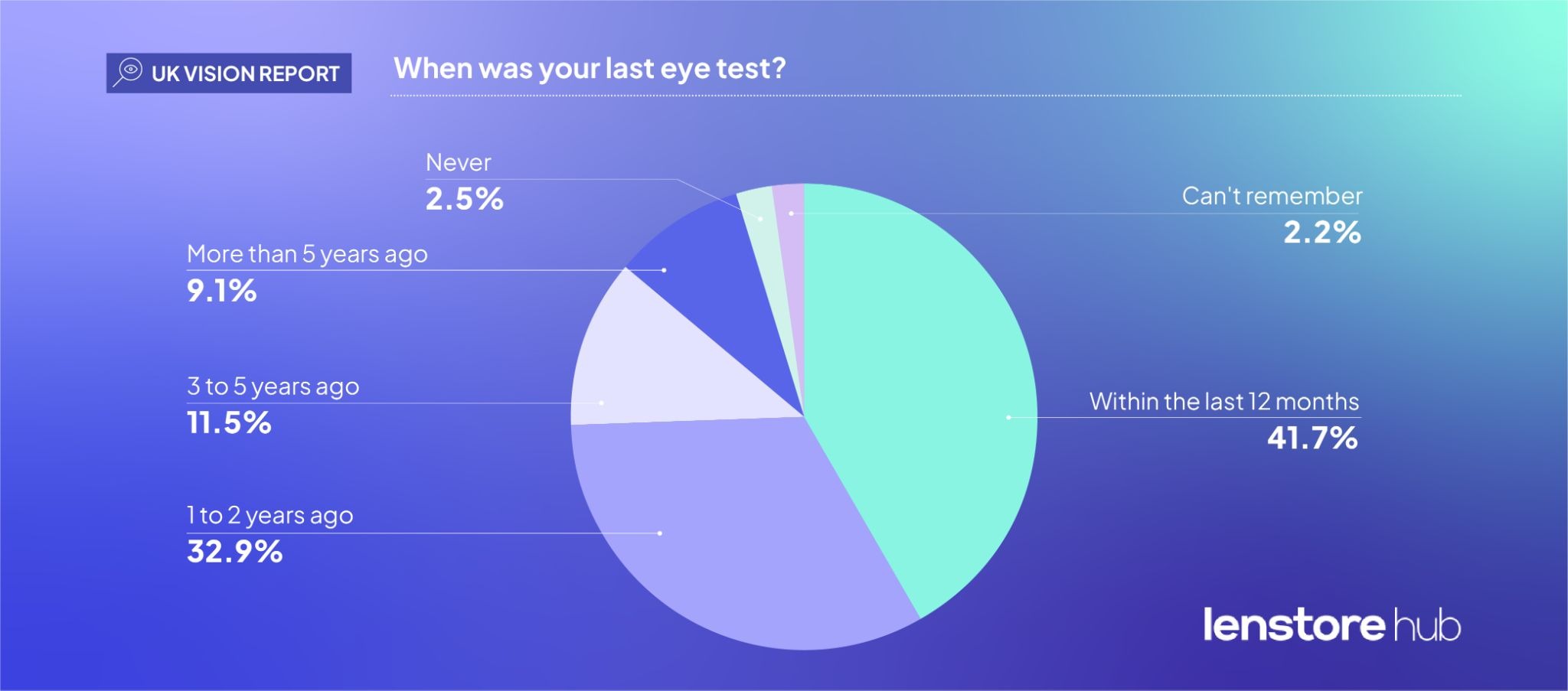
Almost one in ten (9.1%) haven't had an eye test in more than five years
9.1% of respondents have not had an eye test in more than five years, according to Lenstore's UK Vision Report 2026. A further 11.5% last had one three to five years ago, meaning roughly one in five respondents are well outside the recommended two-year interval.
Around four in ten (41.7%) said they had their eyes tested within the last year, while a further 32.9% had done so between one and two years ago. Thankfully, only a small proportion of respondents said they had never had an eye test (2.5%), while a further 2.2% couldn't remember when they last had one.
When was your last eye test? | Share of respondents (%) |
|---|---|
Within the last 12 months | 41.7% |
1 to 2 years ago | 32.9% |
3 to 5 years ago | 11.5% |
More than 5 years ago | 9.1% |
Never | 2.5% |
Can't remember | 2.2% |
One in six (15.6%) say they can’t afford eye tests
Cost is a barrier to eye tests in the UK. Among adults who have not had an eye test in two or more years, 15.6% say they cannot afford one, according to Lenstore's UK Vision Report 2026. However, the most common reason for putting off a test is simply not getting round to it (28.4%), followed by not thinking one is needed (25.9%).
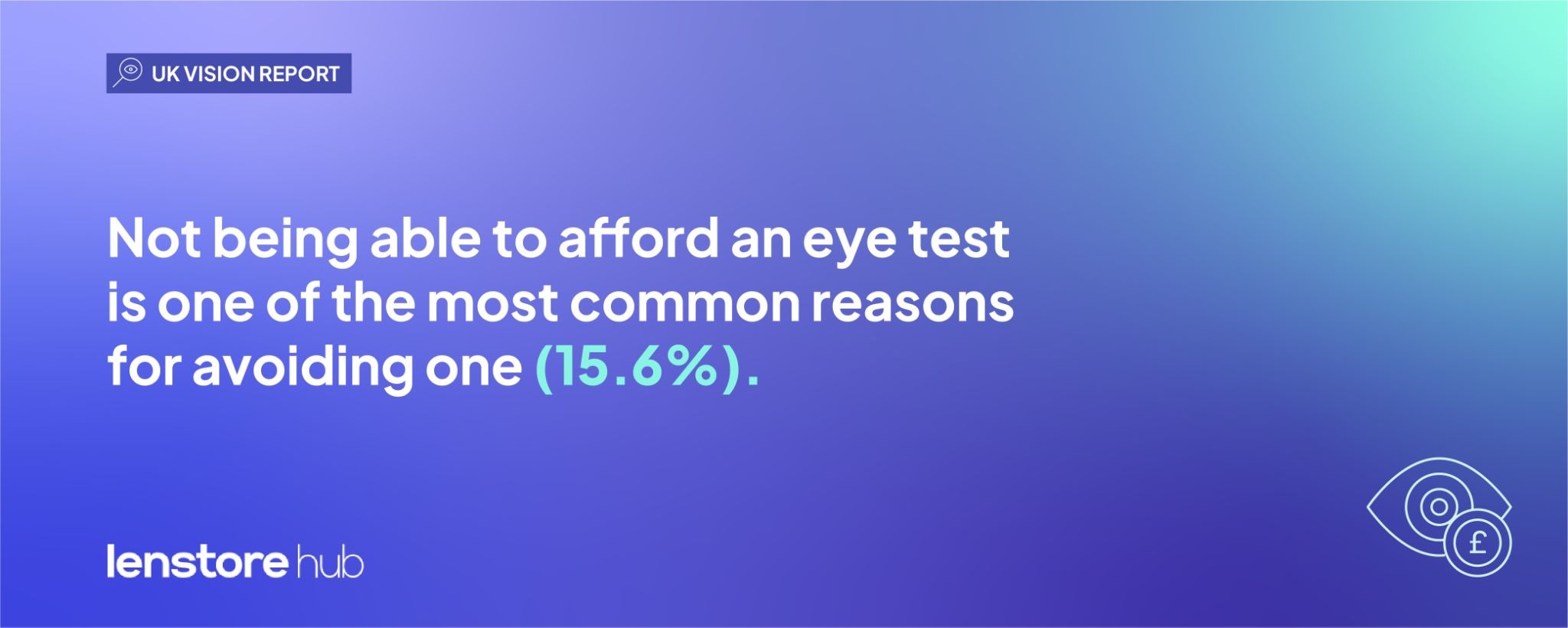
The cost barrier peaks in mid-life. 24.6% of 45 to 54 year olds who have gone two or more years without an eye test say they cannot afford one, the highest of any age group, followed by 35 to 44 year olds (22.1%) and 25 to 34 year olds (22%).
Morgan comments, "An NHS-funded eye test is free for a lot more people than realise it: anyone under 16, under 19 in full-time education, over 60, diabetic, with glaucoma or a close family history of it, or on certain benefits. If cost is the reason someone is putting a test off, the first thing I'd say is check whether you qualify, because a large share of the people telling us they can't afford it may not need to pay."
The cost of glasses would be the biggest concern for many (43.7%)
It seems the cost of an eye test itself isn’t the only financial consideration.
If an eye test showed they needed glasses, the cost of glasses would be the biggest worry for 43.7% of respondents, according to Lenstore's UK Vision Report 2026. This was followed by concerns that needing glasses could be a sign their eyesight was deteriorating, cited by a quarter (25.6%).
Meanwhile, 23.9% said they would be most concerned about having to wear glasses every day, while a similar proportion (23.7%) were most concerned about how they would look wearing them.
Interestingly, attitudes also varied by age. Those aged 18-24 were more likely to be concerned about how they would look wearing glasses, with 18.9% selecting this as a concern, compared with just 6.8% of participants aged 55-64. The youngest group were also particularly concerned about the cost of glasses, with 28.6% highlighting this as a concern.
Other concerns were less common, including how wearing glasses might affect work (11.9%) or driving (14.7%).
21.2% of participants reported already wearing glasses or contact lenses.
Rank | Concerns if an eye test recommend glasses | Share of respondents (%) |
|---|---|---|
1 | The cost of glasses | 43.7% |
2 | It being a sign that my eyesight is deteriorating | 25.6% |
3 | Having to wear glasses every day | 23.9% |
4 | How I'd look wearing glasses | 23.7% |
5 | I already wear glasses/contact lenses | 21.2% |
6 | It affecting my driving | 14.7% |
7 | It affecting my work | 11.9% |
8 | Nothing would concern me | 9.8% |
Almost one in six (14.4%) have delayed an eye test due to concerns about driving or independence
For some, concerns about the potential impact of an eye test result extend beyond the cost of glasses. We asked participants whether they had ever delayed or avoided an eye test because they were worried about how the results might affect their driving or independence.
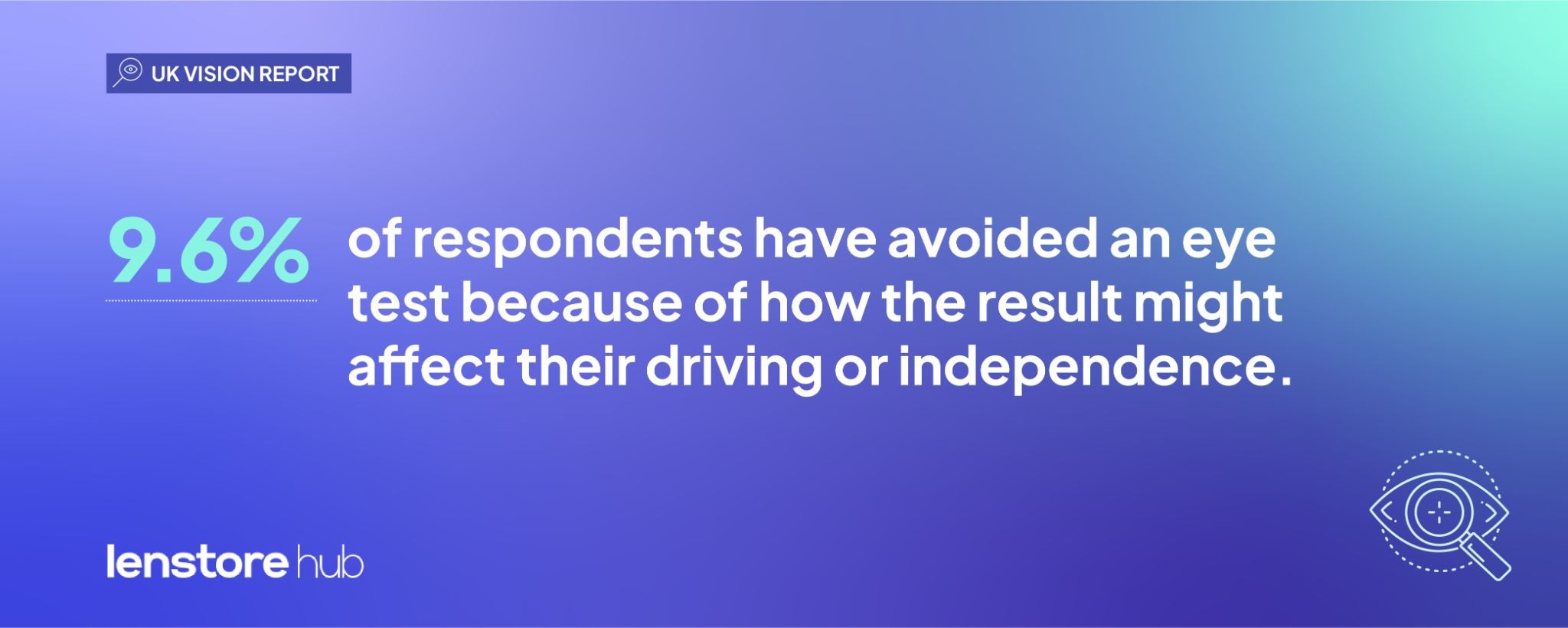
14.4% of respondents have delayed an eye test because they were worried the result could affect their driving or independence, and a further 9.6% have avoided having one altogether for the same reason, according to Lenstore's UK Vision Report 2026. For most (66.2%) this has never been a concern.
Should eye tests be mandatory for older drivers?
With concerns around driving and independence emerging as a reason some delay or avoid eye tests, we wanted to find out how people feel about making eyesight checks a requirement for older drivers.
In Great Britain, entitlement to drive expires at the age of 70. [1] Once a driver reaches 70, they must renew their driving licence and continue to do so at most every 3 years. [1]
The UK government is considering introducing a mandatory eye test for drivers aged 70+ when they renew their driving licence. [1]
We asked our survey participants for their thoughts on the proposed introduction of mandatory eye tests, and the results showed overwhelming support.
68.6% of respondents say mandatory eye tests for drivers aged 70 and over should definitely be introduced when they renew their licence, and a further 29% say they probably should, according to a Lenstore survey of 1,030 UK adults conducted in August 2026. Combined, 97.6% support the proposal. Only 2.3% are against it (2% probably not, 0.3% definitely not).
Support does not fall with age. The group closest to the 70+ threshold, 55 to 64 year olds, is the most supportive: 72.7% say mandatory testing should definitely be introduced, compared with 64.5% of 18 to 24 year olds.
Morgan adds, "The legal eyesight requirements for driving include being able to read a number plate from 20 metres, as well as meeting minimum standards for visual acuity and field of vision. The number-plate check is therefore only one part of the legal requirements, and it is a relatively low bar compared with a comprehensive eye examination. Vision changes gradually, so people may genuinely not notice if they have slipped below it."
Could screen time be affecting our eye health?
With screens now playing such a significant role in everyday life, from working on computers to scrolling on smartphones and watching TV, we wanted to explore whether participants are aware of the potential impact of screen use on their eyes.
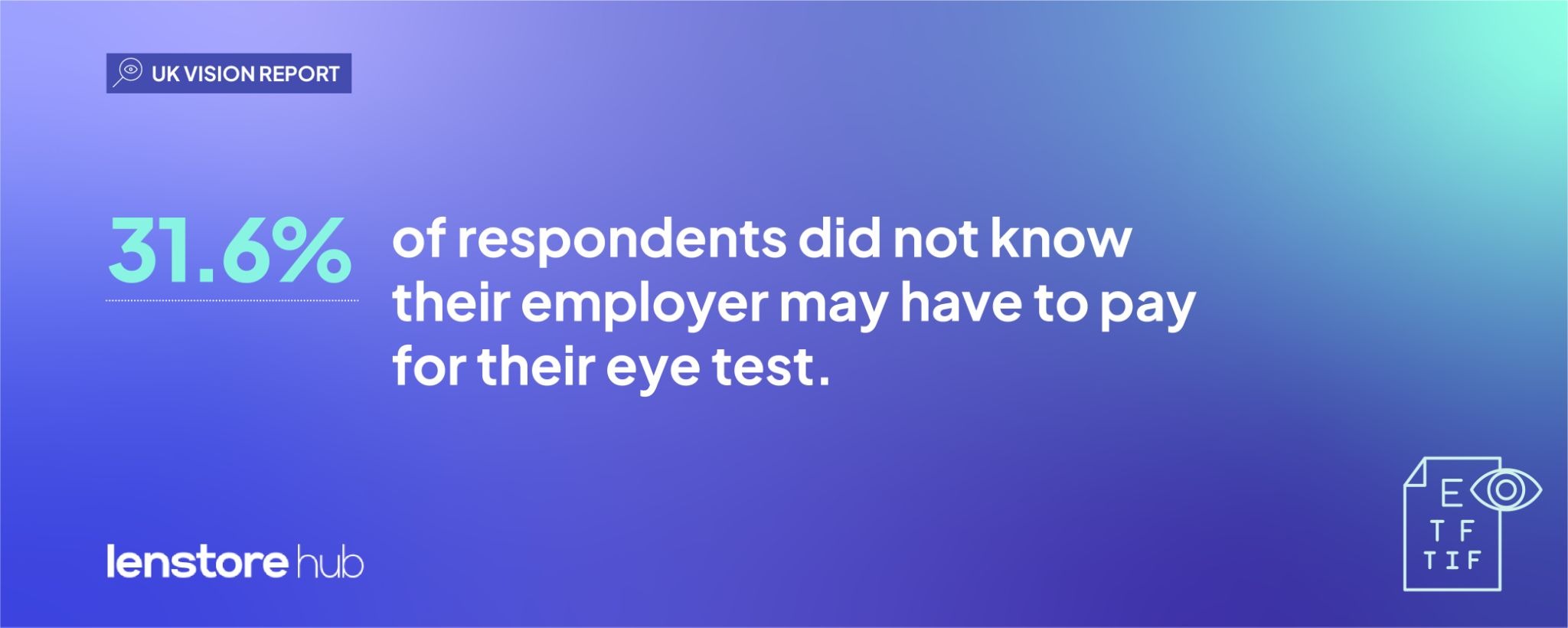
Under the Health and Safety (Display Screen Equipment) Regulations 1992, UK employers must provide an eye test on request for employees who regularly use screens as a significant part of their work, and contribute to the cost of glasses if they are needed specifically for screen use. [2] Yet 31.6% of respondents did not know this, according to Lenstore's UK Vision Report 2026.
Meanwhile, 21.8% said they were aware that their employer may be required to cover the cost, but they hadn’t asked them to do so. A further 13.2% were also aware of this, but said their employer doesn’t pay for their eye tests.
Slightly over a fifth (21.1%) said they were aware of the rule and that their employer does pay for their eye tests.
Almost two-fifths (39.2%) spend 5 to 7 hours a day looking at screens
So, just how much time are participants actually spending in front of screens?
39.2% of respondents spend 5 to 7 hours a day looking at screens across phones, computers and TVs, the most common answer in Lenstore's UK Vision Report 2026. A further 23.9% spend 8 to 10 hours, and 9.1% spend more than ten hours a day.
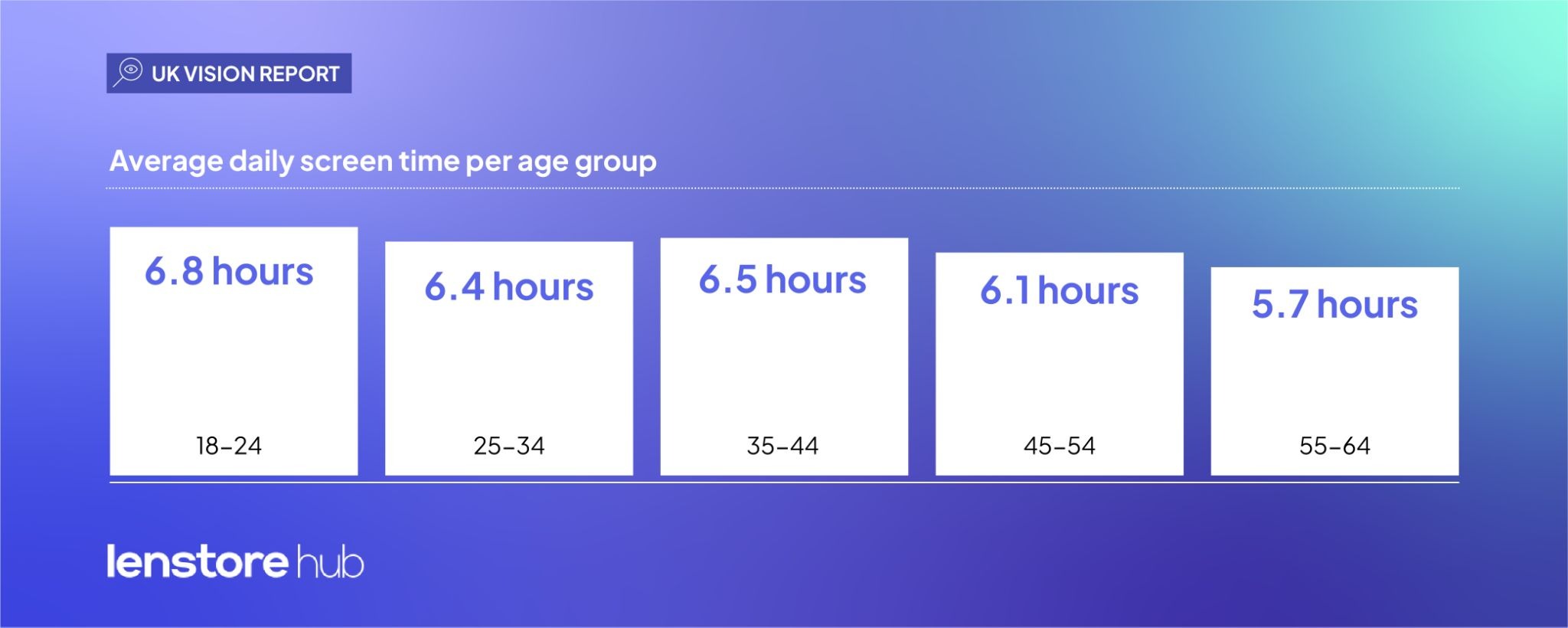
18 to 24 year olds in the study spend an average of 6.8 hours a day on screens, the highest of any age group, compared with 5.7 hours for 55 to 64 year olds, according to Lenstore's UK Vision Report 2026.
Age group | Average daily screen time (hours) |
|---|---|
18 to 24 | 6.8 |
25 to 34 | 6.4 |
35 to 44 | 6.5 |
45 to 54 | 6.1 |
55 to 64 | 5.7 |
Participants report negative side effects from daily screen use
Spending hours looking at screens appears to be taking its toll on some participants' eyes. We asked participants whether they experience common eye health issues after prolonged screen use, and how often these symptoms occur. These included eye strain, dry eyes, headaches, blurred vision, difficulty focusing and tired eyes.
Eye strain was one of the more commonly reported symptoms, with almost a quarter (24.8%) saying they experience it daily after prolonged screen use. A further 30.9% experience it weekly, while 29.4% said they never experience eye strain following prolonged screen use.
Dry eyes were slightly less common. While 19% of participants said they experience dry eyes daily, 38.1% said they never notice this symptom after prolonged screen use.
Headaches were reported less frequently, with 13.3% experiencing them daily and 28.9% experiencing them weekly after prolonged screen use. Meanwhile, a quarter (25%) said they never experience headaches as a result of spending prolonged periods looking at screens.
Blurred vision was a daily occurrence for over one in six (16.7%) participants, while over two-fifths (44.8%) said they never experience it following prolonged screen use.
Difficulty focusing was another common issue, with a fifth (20.1%) saying they experience this daily after screen use. Slightly more (21.4%) experience difficulty focusing weekly, while 38.6% said they never experience this following prolonged screen time.
Tired eyes were the most frequently reported symptom, with over a third (34%) saying they experience them daily after using screens for prolonged periods. A further 30.1% experience tired eyes weekly, while just 16.9% said this is something they never notice.
Symptom after prolonged screen use | Daily | Weekly | Never |
|---|---|---|---|
Tired eyes | 34.0% | 30.1% | 16.9% |
Eye strain | 24.8% | 30.9% | 29.4% |
Difficulty focusing | 20.1% | 21.4% | 38.6% |
Dry eyes | 19.0% | 25.8% | 38.1% |
Blurred vision | 16.7% | 19.6% | 44.8% |
Headaches | 13.3% | 28.9% | 25.0% |
What people think harms eye health, and what the evidence says
We asked participants which things they thought could negatively affect eye health, revealing what people are most aware of when it comes to protecting their vision.
Rank | Believed to negatively affect eye health | Share of respondents | Optometrist's verdict |
|---|---|---|---|
1 | Screen time | 15.9% | Causes temporary strain, not permanent damage |
2 | Sleep | 13.8% | Lack of sleep produces visible short-term signs |
3 | Reading in poor light | 10.7% | Myth: temporary strain only |
4 | Sitting too close to the TV | 10.1% | Myth: no lasting harm |
5 | UV exposure | 9.7% | Real and under-recognised risk |
6 | Genetics | 9.2% | Real: a major factor in many conditions |
7 | Wearing someone else's glasses | 8.7% | Temporary discomfort, not damage |
8 | Using screens in the dark | 8.5% | Temporary strain only |
9 | Diet | 8.1% | Real: diet influences long-term eye health |
10 | Wearing contact lenses too long | 5% | Real: raises infection risk |
Screen time is what respondents most often blame for harming their eyes (15.9%), yet it is one of the least understood. "Screens do not cause permanent damage," says Morgan, optometrist at Lenstore. "What they cause is digital eye strain: you blink less, you focus at one distance for hours, and your eyes get tired and dry. The 20-20-20 rule, looking at something 20 feet away for 20 seconds every 20 minutes, is the simplest fix, and having regular eye tests picks up anything that isn't just strain."
If your eyes feel tired or uncomfortable after spending time looking at screens, using eye drops can help to alleviate some of these symptoms.
Sleep was another factor highlighted by participants, with 13.8% saying that sleep, or a lack of it, can negatively affect eye health. Our experts agree that there are visible signs that can accompany a lack of sleep, including puffy or red eyes and eye twitching. These are just some of the signs your eyes could be telling you about your health.
10.7% of respondents believe reading in poor light damages eyesight. But our experts say it does not. "Reading in dim light makes your eyes work harder and feel tired, but there is no evidence it causes lasting damage," says Morgan. "The same is true of sitting close to the TV, which 10.1% still believe is harmful."
Only 9.7% of respondents named UV exposure as harmful to eye health, yet it is one of the best-established risks. UV radiation from sunlight is linked to eye conditions such as cataracts, macular degeneration and photokeratitis. "UV is the one people underestimate," says Morgan. "Wearing the right sunglasses can significantly improve your protection against UV exposure. Wraparound-style sunglasses offering both 100% UVA and UVB protection are ideal, as they can help shield your eyes from direct UV rays while also providing additional coverage around the sides to protect against dust, contaminants and pollen.”
Diet was also highlighted by 8.1% of participants as something that can negatively affect eye health. A healthy, balanced diet can play an important role in supporting overall health, including the health of your eyes. While factors such as genetics can have a significant influence on eye health, research has also shown that what you eat can affect your eyes, with different diets and eating habits potentially playing a role in maintaining healthy eyesight and reducing the risk of certain eye conditions.
Just 5% of respondents think wearing contact lenses for too long can harm their eyes, the lowest of any factor we asked about, but it is a genuine risk. "Daily lenses are designed for a single day," says Morgan. "Sleeping in them or stretching them over several days lets bacteria build up and increases the chance of infection. If you're in lenses for long hours, a proper wearing schedule matters more than most people think."
Frequently asked questions
How often should you have an eye test in the UK?
At least once every two years for most adults, and more often if you are diabetic, have a family history of glaucoma, or your optometrist advises it. Lenstore's UK Vision Report 2026 found 41.7% of respondents had a test in the last 12 months, but 9.1% have gone more than five years without one.
Does my employer have to pay for my eye test?
If you regularly use a screen as a significant part of your job, UK employers must provide an eye test on request and contribute to glasses needed specifically for screen work, under the Display Screen Equipment Regulations 1992. Lenstore's 2026 survey found 31.6% of respondents did not know this.
Will eye tests become mandatory for drivers over 70 in the UK?
The government is consulting on requiring an eye test when drivers aged 70 and over renew their licence, which they must do every three years. Public support is very high: 68.6% of respondents say it should definitely be introduced and 29% say it probably should (Lenstore UK Vision Report 2026).
Who is entitled to a free NHS eye test?
Morgan says, “There are several exemptions that may entitle you to a free NHS eye test. These include being under 16, under 19 and in full-time education, aged 60 or over, having diabetes or glaucoma, having a close family history of glaucoma, receiving certain benefits, or meeting other qualifying criteria.” Find out more about eligibility for a free NHS eye test on the NHS website.
Does screen time damage your eyes?
No permanent damage has been shown, but prolonged screen use causes digital eye strain. In Lenstore's 2026 survey, 34% of respondents experience tired eyes daily and 24.8% experience eye strain daily after long periods on screens.
The 20-20-20 rule and regular eye tests are the recommended responses.
Is reading in dim light bad for your eyes?
No. Reading in low light makes your eyes work harder and can feel tiring, but it does not cause lasting damage. 10.7% of respondents still believe it does (Lenstore UK Vision Report 2026).
Methodology
The UK Vision Report is Lenstore's study of eye health habits and attitudes. The 2026 edition surveyed 1,030 UK adults aged 18 to 64 in August 2026. Results are unweighted. Figures may not sum to 100% due to rounding.
Demographics for the survey:
Age:
- 18-24 - 11.8%
25-34 - 20.4% - 35-44 - 26.5%
- 45-54 - 22.5%
- 55-64 - 18.8%
Gender:
- Female - 56.5%
- Male - 43.5%
Sources
[1] Gov.uk, ‘Introducing mandatory eyesight testing for older drivers’, 2026
[2] Health and Safety Executive, ‘Working safely with display screen equipment’