
What is base curve and diameter on contact lenses?
When you order contact lenses, you’ll see measurements listed on your prescription and packaging — most commonly BC (base curve) and DIA (diameter).
These numbers determine how your contact lenses fit on your eye. A correct fit helps ensure:
- Clear, stable vision
- Comfortable wear throughout the day
- Healthy contact lens movement
- Proper oxygen flow to the cornea
Even small differences in these measurements can affect how your lenses feel and perform.
What is the base curve (BC) on contact lenses?
The base curve refers to how curved the contact lens is.
Soft contact lenses typically have a base curve between 8.3mm and 9.0mm. This measurement is designed to match the natural curvature of your cornea (the clear front surface of your eye).
- A higher number = a flatter lens
- A lower number = a steeper lens
If the base curve is not correct for your eye:
- The lens may feel tight or uncomfortable
- It may move too much or not enough
- Your vision may appear blurry
This is why base curve should always match your prescribed contact lens fitting.
What does diameter (DIA) mean?
The diameter is the width of the contact lens from edge to edge.
It usually ranges between 13.80mm and 14.50mm, with 14.00mm and 14.20mm being the most common sizes in soft lenses.
The diameter ensures the lens:
- Covers the correct area of your eye
- Sits securely without being too tight
- Moves naturally when you blink
A diameter that’s too small or too large can affect both comfort and visual stability.
How do I find my base curve and diameter?
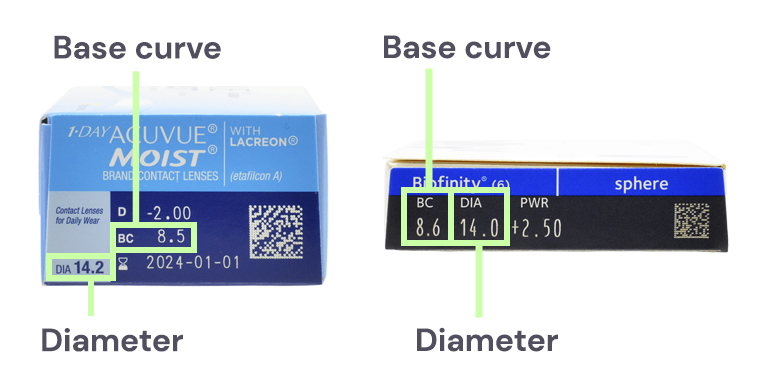
You can find these measurements:
- On your contact lens box
- On your foil blister pack
- On your prescription
Look for:
- BC (or BOZR) for base curve
- DIA for diameter
Always enter these values exactly as prescribed.
Which base curve and diameter should I choose?
You should always order the exact measurements prescribed by your eye care professional.
Even a fractional difference can affect how the lens sits on your eye. An incorrect fit may cause:
- Discomfort
- Redness
- Blurred vision
- Reduced oxygen flow to the cornea
Your optometrist determines your base curve and diameter during a contact lens fitting, where they assess how the lens moves, centres and feels on your eye.
At Lenstore, we’ll alert you if you enter mismatched base curves to help prevent ordering errors.
Can each eye have a different base curve?
In most cases, both eyes will have the same base curve.
Occasionally, your optometrist may prescribe a different lens type or curvature for each eye. This is uncommon but possible.
If this happens, your prescription will clearly show the different values.
Can I buy lenses with different diameters?
Most soft contact lenses are manufactured with a fixed diameter.
You typically cannot choose a different diameter unless you are prescribed a different lens brand for each eye.
If you’re unsure, check your prescription or speak to your optician before ordering.
Do I need the same base curve if I switch lens brands?
Not always.
Even if two lenses share the same base curve number, their material, thickness and design may differ. These factors can influence how the lens fits and how much oxygen reaches the eye.
If you’re switching:
- From clear to coloured contact lenses
- From daily to monthly lenses
- Between different brands
You should have a new contact lens fitting to ensure the lens is suitable.
For example, coloured lenses have a fixed viewing aperture (the clear centre you see through). This is separate from base curve and must align correctly with your pupil size to avoid blurred vision.
What happens if my contact lenses don’t fit properly?
Poorly fitting lenses can cause:
- Persistent discomfort
- Excessive lens movement
- A tight or suction-like feeling
- Blurry or fluctuating vision
If this happens, stop wearing the lenses and book an appointment with your optometrist.
A well-fitted lens should feel comfortable, move slightly when you blink and provide clear, stable vision.
When should I book a contact lens check-up?
You should arrange a review if:
- Your lenses feel uncomfortable
- Your vision changes
- You switch lens types
- You haven’t had a check-up in 12 months
Regular eye exams and contact lens reviews help protect your long-term eye health and ensure your lenses continue to fit correctly.
If you are an existing or new Lenstore customer then you are able to get a contact lens fitting for FREE at our sister company Vision Express. Click the free contact lens check and eye test page.
