
Contact lens intolerance: signs, causes, and what to do
Your lenses used to disappear the moment you put them in. Lately they nag. They feel dry by lunchtime and gritty by the afternoon. You want them out before dinner. That slow loss of comfort has a name: contact lens intolerance. It's rarely the end of wearing lenses. It's a sign that something about your lenses, your routine, or your tears has stopped agreeing. Most of it is fixable once you know what to look for. Let's walk through the signs, the usual causes, and what to do next.
What contact lens intolerance actually means
Intolerance is not the same as one uncomfortable day. Anyone can catch a lash behind a lens. Anyone can push through a dusty commute. Intolerance is the pattern underneath those one-offs. Lenses that once felt like nothing now feel like something. The comfortable part of your day keeps getting shorter.
Wear time is the clearest early clue. Say you used to manage 14 hours. Now you're done by mid-afternoon. That shrinking window means something. Dryness during lens wear is common, and it can be worse with some lens types than others. [1] Naming the pattern helps, because it points you to a fix. It's a reason to see your optician, not a reason to stop. And it isn't something to diagnose yourself from a list.
The signs to watch for
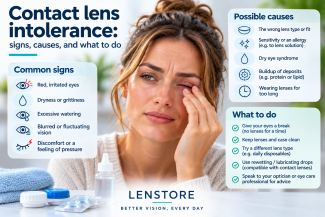
Contact lens intolerance rarely shows up as one big symptom. It builds from a few smaller ones. You'll usually notice two or three at once, not the whole set. The common signs are:
- dryness and a gritty, sandy feeling, often worse later in the day
- redness that creeps in the longer your lenses stay in
- blurring that clears when you blink hard, or lifts the moment you take the lens out
- eyes that water more than usual, as if to make up for something
- a growing urge to take your lenses out early
- light that feels harsher than it should, mostly on screens
Many of these overlap with ordinary dry eye. The NHS describes dry eyes as itchy, sore, gritty, red, or blurry. They can also turn sensitive to light, or water more than normal. [2] The contact-lens version tends to follow your lenses. It's better on glasses days. It's worse the longer a lens stays in. That link to wear is what sets intolerance apart.
Why lenses stop feeling comfortable
Most intolerance comes down to your tear film (the thin layer of tears your lens floats on). A healthy tear film keeps the lens slippery. It also helps feed oxygen to your cornea (the clear window at the front of your eye). When that film thins or dries up too fast, the lens starts to drag on the surface and comfort drops. A few everyday things push it that way.
Evaporation is the main one. Screens make you blink less. Air conditioning, heating, wind, and dusty air all dry the tear film faster. The NHS lists all of these, plus lens wear itself, as things that make dry eye more likely. [2]
Deposits are another cause. On reusable two-weekly and monthly lenses, protein and oils from your tears build up over the weeks. A coated lens feels rougher and less wettable than a fresh one.
Fit and prescription matter too. A lens that sits a little too tight or too loose can nag, which is why a proper contact lens fitting matters. So can a prescription that has moved on since your last check.
Overwear is common as well. Leaving lenses in too long starves the cornea of oxygen, and so does sleeping in lenses not made for it. That's a comfort problem and a safety one. The College of Optometrists advises against wearing lenses longer than your optician says, and against sleeping in lenses unless they're meant for it. [1]
The material counts, too. Older soft-lens materials let less oxygen through than modern silicone hydrogel (a breathable lens plastic). Silicone hydrogel is made to pass up to three times more oxygen to the cornea than traditional soft lenses. The College of Optometrists also says dryness can be worse with some lens types than others. [1]
What you can do about it
Here's the good news. Intolerance is usually something you fix by changing one small thing. You rarely have to give up lenses. Start with your optician. They can watch the lens settle on your eye and work out what to change. [1] A few common fixes are worth knowing first.
Switch to a fresh lens every day. Daily disposables give you a new, clean pair each morning. You bin them at night, so deposits never build up. Our guide to daily vs monthly lenses weighs up the switch. Try own-label everclear ELITE, or 1 Day ACUVUE MOIST, which uses LACREON technology to hold moisture against the eye. Our daily contact lenses range lists the options.
Move to a more breathable material. A silicone hydrogel lens lets more oxygen reach your cornea. ACUVUE OASYS 1 Day is one, built around its HydraLuxe moisture network. Many wearers find it feels fresher over a long day. For more options, see our pick of the best contact lenses for dry eyes.
Top up your tears. A contact-lens-friendly rewetting drop refreshes the tear film mid-wear. Your eyes then do less of the work. Our eye drops range includes preservative-free options (gentler if you use drops several times a day). You can apply them with your lenses in.
Adjust the wear schedule. Sometimes the answer is just fewer hours. The College of Optometrists says that cutting your wear time, or changing lens type, is often all it takes. [1]
If you stay in monthly lenses, keep them clean between wears. Use a multi-purpose solution, which cleans, disinfects, and stores lenses in one liquid. Replace your lens case often, too. Both keep deposits down. Our contact lens solutions hub covers what to use. Contact lenses are medical devices. So check with your optician before you switch to any lens or wear schedule you haven't been prescribed. The right change depends on your eyes.
When to see your optician
Most intolerance is a comfort problem, not an emergency. A routine check-up usually sorts it. Book one if your eyes still feel dry or gritty after a couple of weeks of trying these steps. Book one, too, if your comfortable wear time keeps shrinking. [2] This is the moment to flag what you've noticed. Your optometrist can then match the fix to the cause.
A few signs mean you shouldn't wait. The NHS says to get urgent help (a call to 111) if your eye is painful and red. That's all the more true if you have a red eye while wearing lenses, which can point to an infection. [2] Treat anything that affects your sight as more urgent. If it hurts to look at light, or you notice changes to your vision, get seen the same day. [2] Take your lenses out and wear your glasses until someone has had a proper look.
Getting back to comfortable lenses
Contact lens intolerance is common. For most people it's a prompt to adjust, not to stop. Watch for comfort that fades as the day goes on. Watch for dryness, redness, or blurring that eases the moment the lens comes out. Then match the likely cause to the fix. That might be a fresher daily lens, a more breathable material, a rewetting drop, or simply fewer hours. Run the plan past your optician first. For more on a routine that keeps your lenses feeling good, our eye care hub is a good next step.
Sources
[1] College of Optometrists, lookafteryoureyes.org — dryness is common in contact lens wearers and can be worse with some lens types than others; raising it at a contact lens check-up so the optometrist can suggest changing to a different lens type or reducing wear time; the importance of regular check-ups and of not wearing lenses longer than advised.
[2] NHS, nhs.uk — the symptoms of dry eyes (itchy, sore, gritty, red, blurry, light-sensitive, watery) and the factors that make it more likely (contact lens wear, screen use, air-conditioned or heated environments, wind, and dust); when to see an optician or GP, and the urgent signs (a painful red eye, a red eye while wearing lenses, pain when looking at light, or changes to your sight).