
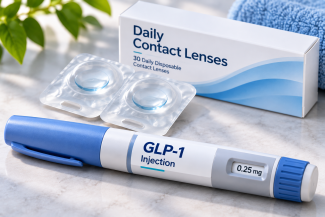
Could Your Weight-Loss Jab Be Changing How You See?
6 minute read
Could Your Weight-Loss Jab Be Changing How You See?
GLP-1 medications are reshaping bodies across the UK — and, it turns out, may be quietly reshaping eyesight too. Here's what contact lens wearers should know before, during and after starting one.
Something odd has been turning up in opticians' chairs over the past couple of years. Patients who've worn the same contact lenses comfortably for a decade suddenly find their vision's gone slightly soft, or their eyes feel drier than usual by mid-afternoon. Ask around and a pattern starts to appear: many of them started a GLP-1 medication a few months earlier.
Drugs like semaglutide and tirzepatide, originally developed for type 2 diabetes, now prescribed far more widely for weight management, work by changing how your body handles insulin, appetite and blood sugar. That's precisely why they can also, indirectly, affect your eyes. The eye's lens is exquisitely sensitive to blood sugar levels, and contact lens wearers, who rely on a stable, well-fitted lens sitting against a healthy tear film, are often the first to notice when something's shifted.
Why blood sugar and eyesight are more connected than you'd think
The lens inside your eye — not to be confused with the contact lens sitting on top of it — is made mostly of water and protein, and it swells or shrinks slightly depending on how much sugar is circulating in your blood. When blood sugar rises or falls quickly, so does the water content of that internal lens, subtly changing its shape and, with it, its focusing power.
This is exactly what can happen as a GLP-1 medication takes hold. As your blood sugar stabilises, often for the better, over the long run, your vision can wobble in the short term. Text might look a touch blurrier than usual, or a contact lens that's fitted you perfectly for years can suddenly feel like it's not quite doing its job. Our guide to why contact lenses go blurry covers the other common causes.
The good news
For most people, this is temporary. As your body settles into a stable blood sugar range — which can take anywhere from a few weeks to a few months, depending on the medication and dose — vision usually returns to where it was. It's rarely a sign that anything's gone wrong; it's a sign your body is adjusting.
The practical takeaway is simple: don't rush to change your contact lens prescription the moment you notice a blur. Give your body time to settle, and if the change persists beyond a couple of months, that's the point to get your eyes properly re-checked rather than guessing at a new lens power.
A well-fitted lens depends on a stable eye surface — which is exactly what's in flux during the first months on a GLP-1 medication.
The dry eye connection
Blurred vision isn't the only thing GLP-1 users report. Appetite suppression means many people are eating and drinking less overall in the first few months, and that can mean less fluid intake than the eyes are used to. Add in a diet that's shifted quite dramatically, and it's not unusual for contact lens wearers to notice their lenses feel drier, grittier or less comfortable by the end of the day than they did before.
There's an interesting flip side, too. Some of the same anti-inflammatory effects that make GLP-1 drugs useful for metabolic health are being studied for their potential to ease chronic dry eye and other inflammatory eye conditions over the longer term. So while the early adjustment period can be uncomfortable, it doesn't necessarily mean things are heading in the wrong direction for your eyes overall.
THE TAKEAWAY
Your eyes are often the first place your body shows a change is happening, sometimes weeks before you'd think to mention anything to your GP.
A rare risk worth knowing about
There's one more thing worth being aware of, even though it's uncommon. Researchers have been studying a possible link between GLP-1 medications and a rare condition called NAION, a type of sudden, painless vision loss caused by reduced blood flow to the optic nerve. The evidence so far suggests any increased risk is small, and mostly relevant to people who already have other risk factors for the condition, such as certain cardiovascular or blood pressure issues.
This isn't a reason to avoid these medications; for most people the benefits comfortably outweigh a genuinely rare risk. It is a reason to take sudden, one-sided vision loss seriously and get it checked immediately rather than waiting to see if it passes.
What to do if you're starting a GLP-1 and wear contact lenses
- Book an eye check when you start the medication, and again once your dose has settled, not just when something feels wrong.
- Mention any new medication to your optometrist, even if your eyes feel completely fine. It genuinely changes what they look for.
- Keep an up-to-date pair of glasses to hand while your prescription is in flux, so you're not stuck if a lens stops feeling right.
- If your eyes feel drier than usual, try preservative-free lubricating drops that are safe to use with lenses, or switch temporarily to daily disposables for a fresh, clean lens every day. Our guide to eye drops and contact lenses explains which types to choose.
- Treat sudden vision loss, double vision, or a sudden painless dimming in one eye as urgent — don't wait it out.
Weight-loss medications are changing a lot of things about how people feel day to day — mostly for the better. Your eyes are just one more part of the body that's adjusting along with everything else. A little patience, and a willingness to flag changes early rather than push through them, is usually all it takes to keep your contact lenses as comfortable as they've always been.
Keep an eye on things
If your vision or lens comfort has changed recently, a quick check-up can tell you whether it's just settling in — or worth adjusting. Lenstore customers get a free eye test, so there's no reason to put it off.
Book your free eye test Shop daily contact lenses
This article is intended for general information and does not replace advice from an optometrist or GP. If you're taking a GLP-1 medication and notice changes to your vision, speak to your eye care professional.