
Can you buy contact lenses without a prescription in the UK?
Can you buy contact lenses without a prescription in the UK?
In the UK, the short answer is no. You can grab ready reading glasses in a supermarket. Contact lenses are different. By law, a shop or website can only sell you lenses if you hold a valid, in-date specification from an eye-care professional. Even zero-powered coloured lenses that do nothing for your sight must be sold under professional supervision. It can sound like red tape. In fact, the rule is there to keep your eyes comfortable and well. Here is what trying to buy contact lenses without a prescription really means, and why the rule works in your favour.
The short answer, and the law behind it
The rule comes from the Opticians Act 1989. It says a seller cannot supply a contact lens to anyone without a valid specification. [1] A specification is the formal name for what most people call a contact lens prescription. The sale must also be made under the right supervision. That means a registered optometrist, dispensing optician, or doctor. [1] [3] Simple reading glasses are treated differently. The same Act lets shops sell them up to +4 dioptres with no supervision at all. [1] A lens that sits on your eye is held to a higher bar, and for good reason.
A specification is not the same as a glasses prescription
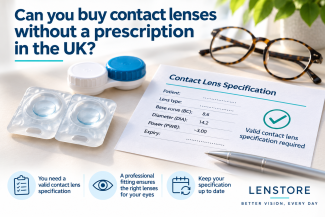
Your glasses prescription and your lens specification are not the same thing. Glasses numbers describe lenses that sit about 12mm from your eye. A contact lens rests right on the tear film. So it needs its own measurements. A specification records the details needed to replicate your exact lens: [3]
- the power, measured in dioptres
- the base curve and total diameter, both in millimetres
- the lens material, brand, and design
- the fitter's name and General Optical Council (GOC) number
- the fitting date and the expiry date
Those fit numbers are why you cannot copy a glasses prescription onto a lens order. If you are still deciding between the two, our guide to contact lenses vs glasses weighs them up.
Why the eye check comes first
If you are new to lenses, the fitting is where it all starts. Only a registered optometrist, dispensing optician, or doctor may carry one out. [2] The fitting is where your measurements come from. Your optician watches how a lens moves on the eye. They check how the tear film copes. And they find which base curve and diameter actually suit you. The visit also confirms whether lenses are a good idea at all. That is why a specification carries an expiry date, usually set to your next check. [2] [3] A lens sits on the eye for hours, so the surface underneath it needs to stay healthy. It helps to read what a contact lens fitting involves before you book.
Coloured and zero-powered lenses follow the same rule
Maybe you only want coloured lenses for a one-off party look. It is tempting to treat those as fashion, not medical. They are not. A zero-powered (plano) lens corrects nothing. Yet it still sits on the eye like any other lens. The Opticians Act treats it the same way. So a plano coloured lens must also be sold under the supervision of a registered professional. [1] In practice that still means a fitting by a registered optometrist, dispensing optician, or doctor, [2] and they should give you a written specification, even for a single night out. [3] You can browse coloured contact lenses once you have been fitted. Then the colour is the only thing left to pick.
What you give up by buying from an unregulated seller
Say you spot lenses on a market stall or a novelty website. They are often sold with no questions asked. The trouble is what comes with them, which is nothing. No one verifies your details with your optician. [3] There is no fitting, so the base curve may be wrong for your eye. The Act also makes a proper seller arrange aftercare. A novelty stall will not do that. [1] A lens with the wrong base curve can feel uncomfortable or sit poorly on your eye. If a lens ever leaves your eyes red or sore, take it out and see an optician. A regulated seller keeps all of those safeguards for you.
How buying online actually works
Buying online is not a loophole. It follows the same law as the high street. When you order from Lenstore, you enter the details from your specification. We can then verify them with the optician who issued it. [1] The sale runs under professional supervision, just as the Act requires. If you do not have the paper copy to hand, our page on ordering contact lenses without a prescription explains your options. Once you are set up, reordering is quick. A daily lens like 1 Day ACUVUE MOIST is one easy option. So is our own-label everclear ELITE. Each gives you a fresh pair every morning with nothing to clean. You will find the full choice on our daily contact lenses page, all sold the regulated way.
Book your check, then order with confidence
So you cannot buy contact lenses without a prescription in the UK, and that is genuinely good news. The specification is what makes sure your lenses fit your eyes and suit them. New to lenses? Book a contact lens check first. Ask the optician for a copy of your specification. If yours has lapsed, a quick eye health check-up brings it back up to date. From there, our eye care advice can help you settle in. Get the check, get the specification, and the rest is the easy part.
Sources
[1] Opticians Act 1989, section 27 (Sale and supply of optical appliances) — a contact lens may not be sold to anyone without a valid specification; zero-powered lenses must be sold by or under the supervision of a registered professional; the sale must be made before the specification's expiry date, and the seller must arrange aftercare. legislation.gov.uk
[2] Opticians Act 1989, section 25 (Fitting of contact lenses) — only a registered optometrist, dispensing optician, or doctor may fit contact lenses, and the specification issued on completion of the fitting must state its validity period and expiry date. legislation.gov.uk
[3] College of Optometrists, 'Contact lens specification' — the information a specification must contain, that lenses must not be supplied once it has expired, and that patients may buy from any supplier working under professional supervision. college-optometrists.org