
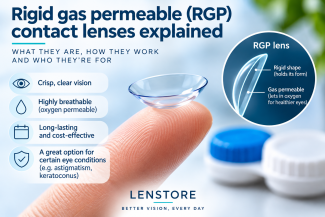
Rigid gas permeable (RGP) contact lenses explained
Pick up a soft contact lens and it flops over your fingertip. Pick up a rigid gas permeable lens and it holds its shape, like a tiny clear button. That firmness is the whole point: on the right eyes it gives sharper vision than a soft lens can, and it's the reason these lenses are fitted a little differently from the box you order online.
Rigid gas permeable lenses go by RGP for short, and some still call them hard lenses. They're a specialist option, not an everyday default. Here's what they are, how they differ from soft lenses, who they suit, and how you'd get a pair.
What rigid gas permeable lenses are
Most contact lenses are soft, folding over your fingertip and moulding to your eye. Rigid gas permeable lenses are the other main type, and they work the opposite way. They're firm, they hold their own shape, and they rest on your eye rather than draping over it. [1]
The 'gas permeable' part of the name is the bit that matters. It means oxygen passes straight through the lens to the front of your eye. That ability is measured as the material's Dk, an index of oxygen permeability with no everyday unit, so a higher Dk simply means more oxygen gets through. It sets modern RGP lenses apart from the hard lenses of decades ago, which sealed the eye off and couldn't be worn for long. Today's rigid lenses breathe, which is far kinder to your eye over a long day. [1]
They're small, firm discs, a touch smaller than a soft lens. They're tougher, too: the surface resists the protein and oil deposits that cloud soft lenses. The lens is also far harder to tear. [1]
How RGP lenses differ from soft and silicone hydrogel lenses
That firmness changes how the lens behaves on your eye. Soft lenses drape over the whole cornea and barely move, silicone hydrogels (a newer, more breathable soft material) included. A rigid lens is smaller, so it floats on your tear film and shifts a little with each blink. That movement works like a tiny pump, flushing fresh tears underneath to keep the surface clean.
Here's how the two types compare:
| Soft lenses | Rigid gas permeable lenses | |
|---|---|---|
| Feel | Comfortable almost at once | Noticeable at first, settles in weeks |
| Material | Flexible, water-containing plastic | Firm, oxygen-permeable plastic |
| On the eye | Drapes and barely moves | Smaller, moves with each blink |
| Lifespan | Daily, two-weekly, or monthly | Reused for many months, far longer than disposables |
| Vision | Great for most prescriptions | Often crisper, especially on uneven corneas |
Because a rigid lens keeps its shape, many wearers see noticeably crisper vision. And one pair lasts far longer than a disposable, often one to two years. [1] [3]
Why rigid lenses can sharpen vision
The crisp vision comes down to a neat trick with your tears.
Your cornea is the clear dome at the front of your eye, and it does most of your focusing. If its surface is even slightly uneven, light scatters and your sight blurs. A soft lens moulds to that uneven surface, so the unevenness stays. A rigid lens doesn't, because it holds its own smooth, regular curve. A thin layer of tears then fills the gap between the lens and your cornea, and opticians call that layer the tear lens. Your eye focuses through its smooth front surface, not its own irregular one. The image comes out cleaner and sharper. [2]
That's why rigid lenses matter most for eyes that soft lenses can't quite correct.
Who rigid gas permeable lenses suit
Rigid lenses aren't usually the first choice for a straightforward prescription. A soft lens does that job comfortably. Rigid lenses earn their place with eyes that need something more precise.
- Uneven or cone-shaped corneas. In keratoconus, the cornea slowly thins into a more cone-like shape. Glasses or soft lenses then can't keep up. People with keratoconus usually wear RGP lenses, because the rigid surface masks the uneven shape. [2]
- Stronger or awkward astigmatism. Astigmatism means the cornea is shaped more like a rugby ball than a football, and soft toric lenses handle most cases well, so start with our contact lenses for astigmatism. A rigid lens can give steadier, sharper vision when the astigmatism is high.
- Presbyopia. Near focus fades with age. Multifocal RGP lenses can build several focal zones into one firm lens.
- Overnight reshaping. A few rigid lenses are made and approved to be worn in bed. Known as ortho-k, they gently reshape the cornea overnight. You then see clearly the next day with no lenses in. [1]
Whichever applies, this is a decision to make with an optometrist, never alone. They'll check your eyes are suited before fitting anything. They can also explain scleral lenses, a large-diameter cousin of the standard RGP lens that vaults over the cornea entirely, and you can read more in our guide to scleral contact lenses. Another option is hybrid contact lenses, which pair a rigid centre with a soft outer skirt.
Getting used to rigid lenses
There's no dressing it up: a rigid lens feels more noticeable than a soft one at first. You'll sense the edge of the lens when you blink, which is normal and soon settles.
Most people need a few weeks to adapt to rigid lenses, against a few days for soft ones. [1] [3] The trick is to wear them consistently. Build up your wearing time on the steady daily routine your optometrist sets. Once those first few weeks have passed, the lens usually feels far less noticeable.
Looking after rigid gas permeable lenses
Rigid lenses are reusable, so caring for them is part of the deal. The routine differs a little from soft lenses.
Soft lenses use one all-in-one multi-purpose solution. Rigid lenses often use a small set of products instead. A cleaner lifts the day's deposits. Then a conditioning or soaking solution disinfects the lens and stores it overnight. Boston solutions (from Bausch & Lomb) and Total Care (from AMO) are both made for rigid lenses, and you'll find them beside the soft-lens care on our contact lens solutions pages. Two rules never bend. Never clean or store any lens in water. And never use a solution meant for soft lenses unless your optometrist says so.
Looked after well, one pair of rigid lenses keeps going for many months, long after a run of disposables would have been binned.
How to get rigid lenses, or a simpler soft option
You can't drop rigid lenses into an online basket the way you would a box of dailies. Every pair is made to fit the exact curve of your eye, so they're fitted in person. Expect a scan of your cornea, trial lenses, and follow-up checks to fine-tune the fit. There's the odd review while you wear them, too.
If that sounds like more than you need, soft lenses may suit you better. They still need a fitting with an optometrist or contact lens optician first. You then get a contact lens specification, and you can order the lenses on it from wherever you like. [3] For fuss-free daily wear, 1 Day ACUVUE MOIST use LACREON technology to hold moisture through the day, while own-label everclear ELITE give a comfortable daily option too. Both are single-use: fresh pair in, old pair out, nothing to clean.
Still weighing it up? An optometrist is your next step for a fitting, and our eye care pages point you in the right direction. The right lens is the one your eyes are measured for. That might be a rigid lens for a tricky cornea, or a soft lens you forget you're wearing.
Sources
[1] U.S. Food and Drug Administration, 'Types of Contact Lenses' — RGP lenses are more durable and resist deposit build-up. They usually give clearer, crisper vision and last longer than soft lenses. They are less comfortable at first and can take a few weeks to get used to, against a few days for soft lenses. A small number are approved for overnight wear, as in ortho-k. fda.gov
[2] RNIB (Royal National Institute of Blind People), 'Keratoconus' — people with keratoconus usually wear rigid gas permeable (RGP) lenses. A rigid lens gives a regular front surface that masks the cornea's uneven shape. Sight can then be sharper than with glasses or soft lenses. rnib.org.uk
[3] The College of Optometrists, 'Contact lenses' (Look After Your Eyes) — RGP lenses take a little more getting used to than soft lenses and are usually replaced every one to two years. All contact lenses must be fitted by a qualified optometrist, contact lens optician or doctor, who then gives you a contact lens specification you can buy against. lookafteryoureyes.org